

Why add a second network to the infrastructure you already have?
Many companies have been delivering their website, APIs, or video through a single CDN for years. The setup works, the team knows it, and everything seems to be running smoothly… until it doesn’t.
Adding a second provider (or several) complements that infrastructure without touching what already works, and ensures that your sites remain operational even if there is an interruption in one of the services. That’s the logic of a multi-CDN architecture: several networks in production at the same time, each serving a portion of the traffic.
What is a multi-CDN architecture?
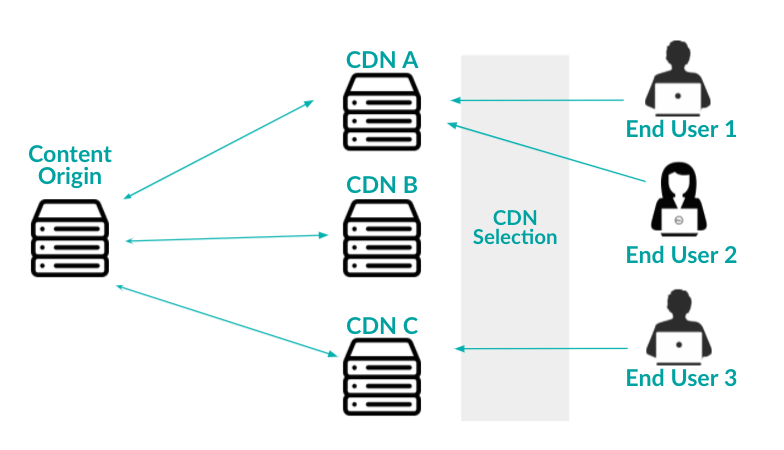
A multi-CDN strategy combines two or more content delivery networks from different providers to serve the same content. Each CDN handles a portion of the requests, and a decision layer, typically in the DNS, determines which network responds to each user.
This decision can take into account the user’s location, their ISP, the health of each network at the time of the request, or a predetermined weight allocation. Traffic is routed to the CDN that performs best at any given time and place, and the potential failure of one of them leaves the service with another option.
What are the benefits of distributing traffic across multiple networks?
➜ Continuity of service
Since both networks handle traffic daily, each has cached content and operates based on actual load. If one of them goes down, simply adjusting the load distribution allows the other(s) to handle its requests, without a cold start and with a behavior the team already understands.
➜ Performance by region and by operator
Each provider has its own PoP distribution and its own interconnection agreements with operators. Combining multiple networks expands coverage and allows each user, depending on their region or ISP, to be routed through the network that best suits their needs, even with decisions based on traffic measurements.
➜ Alternative to a single point of dependency
Any network, regardless of size, can experience a temporary outage at the delivery layer while the source remains operational. With a second CDN configured and serving real traffic, those requests are routed to the other network for the duration of the outage.
A second European CDN
Diversifying providers can also mean diversifying jurisdictions. If all the CDNs serving a European company’s traffic depend on companies outside the EU, the dependency is both technical and legal: it affects which legislation applies to the provider and to the data that passes through its network.
Transparent Edge is a CDN developed and operated in Europe. Adding it as a second network allows some traffic, or traffic the organization considers more sensitive, to pass through European infrastructure without abandoning the current provider.
The European regulatory framework points in the same direction. In the financial sector, the DORA Regulation asks entities to evaluate the risk of concentration when they depend on ICT providers that are difficult to replace (article 29). The NIS2 Directive includes supply chain security among the risk management measures it requires of the entities to which it applies (article 21).
The origin in a multi-CDN scenario
Each CDN maintains its own cache. With two or three networks, the origin can receive the same request repeatedly from each one, increasing the load on the servers and the egress transfer costs. This effect is especially noticeable when moving traffic to a network with a cold cache.
The typical solution is a dedicated mid-tier: an intermediate cache layer that acts as a single point of entry to the origin for all CDNs. For the origin, there is only one client: the mid-tier. Rules affecting the origin’s response, such as CORS headers, are defined once and arrive identically across all networks. And if one CDN experiences problems and its traffic is routed to another, the origin doesn’t become overloaded because the mid-tier already has the necessary content.
How is a multi-CDN architecture implemented?
A typical startup follows these steps:
- Configure the new CDN with the same origin (or the same mid-tier) and the same behavior as the current one: cache rules, headers, redirects, security rules and domain TLS certificates.
- Validate it with a test hostname before sending user traffic to it.
- Define the distribution mechanism: DNS with weighted or geolocation-based responses, or a traffic management service that decides based on the health and measured performance of each network.
- Start with a small portion of the traffic and monitor both networks with the same metrics: errors, latency, and cache hit rate.
- Automate common operations, such as purges, through each provider’s API, and document the switchover procedure, including the TTL of DNS records, which marks how long it takes for a partition change to be applied.
Transparent Edge in your multi-CDN strategy
The Transparent Edge platform supports multi-CDN architectures and is added alongside your existing provider. You can start with a portion of the traffic, measure the results on your own users, and then decide how much volume you want to pass through a European network.
Our support team works with yours during setup and subsequent adjustments, with direct communication and no waiting ages for a ticket response.
If you want to assess how a second European network would fit into your infrastructure, write to us and we’ll look at it in relation to your architecture.
Sonia Arévalo is Product Marketing Manager in Transparent Edge.
How a Systems Analyst ended up studying Food Technology is hard to explain. Add the fact that she later decided to go into Digital Marketing, and it’s a complete mystery how this girl manages to do so many things so well. More Argentinian than asado, Sonia keeps our website and social media running, translating complex
elvishtech-speak into something normal humans can actually understand. “Excelente”—with that unmistakable Argentine flair—is her favorite go-to word, and it perfectly matches the quality of her work.